Painter Provocateur
Bidoun magazine’s Negar Azimi, on Inji Efflatoun’s indomitable artistic spirit
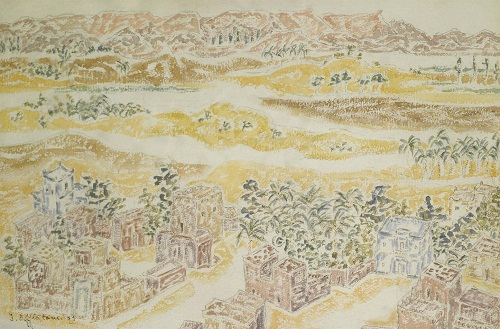
Painter Inji Efflatoun flourished in the vanguard of Egyptian Modernism and political life, but also paid a heavy price for her beliefs. A devoted Marxist and feminist, she was imprisoned for her activism for four years during her thirties. Still she always painted, even in prison — among her most formative years artistically — experimenting with form and color throughout her long career, invoking artists from Max Ernst to Henri Matisse.
As shockwaves of the "Arab Spring" reverberate through her home country some two-and-a-half decades after her death, her artistic, political, and feminist fortitude seems as relevant as ever. Here, Negar Azimi, a senior editor at Bidoun, a Middle East-focused publishing, curatorial, and educational organization, talks about Efflatoun’s, Untitled (1979), and why the artist’s work and life were inseparable.
Surrealism
I first came across Inji Efflatoun's name when I learned about the Egyptian surrealist movement, which, itself, deserves several books — if not films — for its incredible breadth and crooked cosmopolitanism. Efflatoun’s mentors were some of the most interesting Egyptian artists of her day. She met the great Modernist painter, Mahmoud Saïd, at the age of 15 and later was mentored by Kamel El-Telmesany, another of Egypt's modern masters and a protagonist in the incredible surrealist-inflected Art and Freedom Group — an anti-fascist movement founded in 1939 by the poet George Hunain (after a meeting with Andre Breton, no less). Art and Freedom stressed the transgressive qualities of the imagination and to my mind was one of the most exciting 20th century modern movements—perhaps especially because of its Egyptian setting. "Long Live Degenerate Art" was one of its slogans.
Not bourgeois
Though El-Telmesany at first mistrusted a girl of the bourgeois dispensation, he relented once he observed Efflatoun’s intense and idiosyncratic talent. Or so the story goes. One of the young artist's first paintings involved a woman being devoured by fire and ravenous snakes. Another early painting involved a girl running from an encroaching bird. In other words, they were grim — and not exactly bourgeois in ethos!one and the same.
A Painterly Shift
This painting is certainly not as dark as the other two I mentioned and is mysteriously bucolic. It could be the Siwa Oasis, the area around the Saqqara pyramids, or any Egyptian village really. Efflatoun’s interest in ordinary village life and working people’s struggles was especially manifest later in her painterly career. Notice the subdued colors and the white space. In her own words, these works "vibrated" with life. It’s more Bonnard than Max Ernst and reflects a significant shift!
The prolific prisoner
From the beginning, Efflatoun was politically active in feminist and communist circles, eventually spending four years in prison under former President Gamal Abdel Nasser for her activities, starting in 1959. In prison, she continued to paint. Her work and her life — and it's not clear where one begins and the other ends — speak to the incredible intersection of worlds and ideas, nationalisms and internationalisms, that constituted Egypt during parts of the last century.
Efflatoun’s Untitled (1979) is one of many works in Christie’s online-only auction of Modern and Contemporary Arab and Turkish art, running from Oct. 25 through Nov. 11.